
The Key Minerals in an EV Battery
May 1, 2024

By  Graphics/Design: Athul Alexander

Breaking Down the Key Minerals in an EV Battery

Inside practically every electric vehicle (EV) is a lithium-ion battery that depends on several key minerals that help power it.


Some minerals make up intricate parts within the cell to ensure the flow of electrical current. Others protect it from accidental damage on the outside.


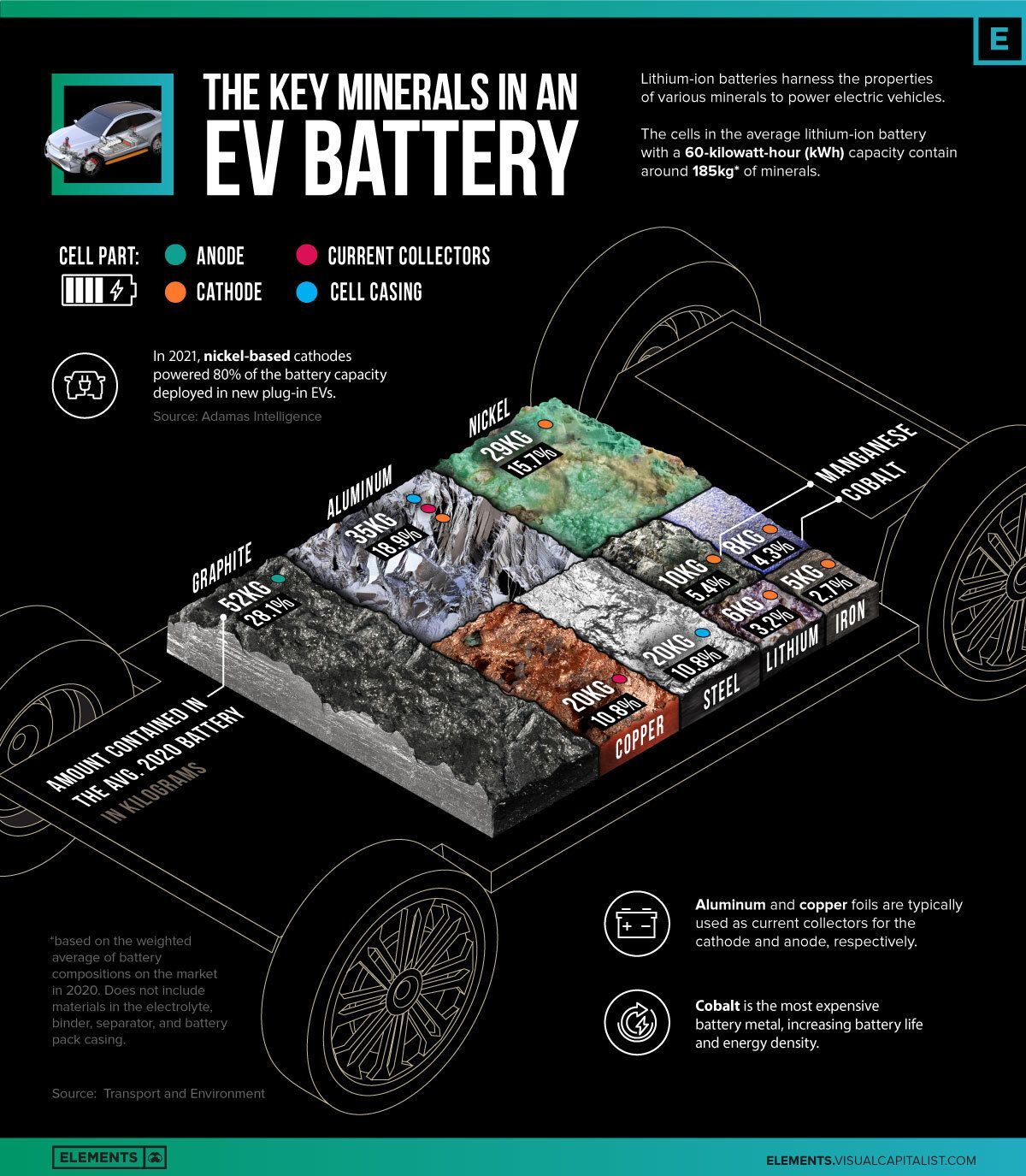
This infographic uses data from the European Federation for Transport and Environment to break down the key minerals in an EV battery. The mineral content is based on the ‘average 2020 battery’, which refers to the weighted average of battery chemistries on the market in 2020.


The Battery Minerals Mix


The cells in the average battery with a 60 kilowatt-hour (kWh) capacity—the same size that’s used in a Chevy Bolt—contained roughly 185 kilograms of minerals. This figure excludes materials in the electrolyte, binder, separator, and battery pack casing.

Mineral Cell Part Amount Contained in the Avg. 2020 Battery (kg) % of Total
Graphite Anode 52kg 28.1%
Aluminum Cathode, Casing, Current collectors 35kg 18.9%
Nickel Cathode 29kg 15.7%
Copper Current collectors 20kg 10.8%
Steel Casing 20kg 10.8%
Manganese Cathode 10kg 5.4%
Cobalt Cathode 8kg 4.3%
Lithium Cathode 6kg 3.2%
Iron Cathode 5kg 2.7%
Total N/A 185kg 100%

The cathode contains the widest variety of minerals and is arguably the most important and expensive component of the battery. The composition of the cathode is a major determinant in the performance of the battery, with each mineral offering a unique benefit.


For example, NMC batteries, which accounted for 72% of batteries used in EVs in 2020 (excluding China), have a cathode composed of nickel, manganese, and cobalt along with lithium. The higher nickel content in these batteries tends to increase their energy density or the amount of energy stored per unit of volume, increasing the driving range of the EV. Cobalt and manganese often act as stabilizers in NMC batteries, improving their safety.


Altogether, materials in the cathode account for 31.3% of the mineral weight in the average battery produced in 2020. This figure doesn’t include aluminum, which is used in nickel-cobalt-aluminum (NCA) cathode chemistries, but is also used elsewhere in the battery for casing and current collectors.


Meanwhile, graphite has been the go-to material for anodes due to its relatively low cost, abundance, and long cycle life. Since the entire anode is made up of graphite, it’s the single-largest mineral component of the battery. Other materials include steel in the casing that protects the cell from external damage, along with copper, used as the current collector for the anode.


Minerals Bonded by Chemistry

There are several types of lithium-ion batteries with different compositions of cathode minerals. Their names typically allude to their mineral breakdown.


For example:

  • NMC811 batteries cathode composition:
    80% nickel
    10% manganese
    10% cobalt
  • NMC523 batteries cathode composition:
    50% nickel
    20% manganese
    30% cobalt


Here’s how the mineral contents differ for various battery chemistries with a 60kWh capacity:
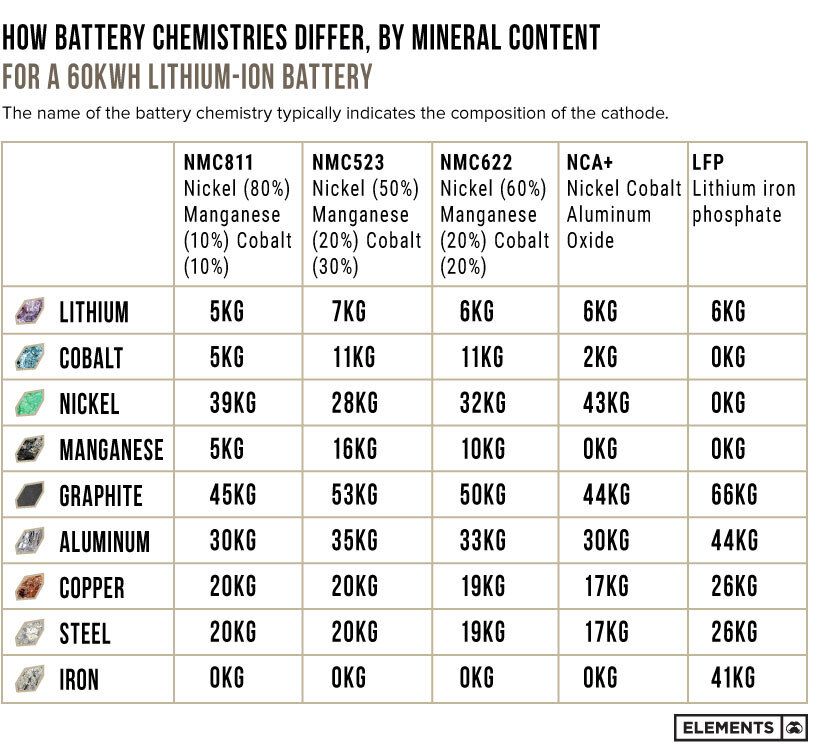
With consumers looking for higher-range EVs that do not need frequent recharging, nickel-rich cathodes have become commonplace. In fact, nickel-based chemistries accounted for 80% of the battery capacity deployed in new plug-in EVs in 2021.


Lithium iron phosphate (LFP) batteries do not use any nickel and typically offer lower energy densities at better value. Unlike nickel-based batteries that use lithium hydroxide compounds in the cathode, LFP batteries use lithium carbonate, which is a cheaper alternative. Tesla recently joined several Chinese automakers in using LFP cathodes for standard-range cars, driving the price of lithium carbonate to record highs.


The EV battery market is still in its early hours, with plenty of growth on the horizon. Battery chemistries are constantly evolving, and as automakers come up with new models with different characteristics, it’ll be interesting to see which new cathodes come around the block.


Copyright © 2024 Visual Capitalist
November 18, 2025
TORONTO, Nov. 18, 2025 - VVC Exploration Corporation, dba VVC Resources ("VVC" or the "Company") (TSX-V: VVC; OTC: VVCVF) announces that, after a project review, it has strategically restructured its mining projects in Mexico. This project review encompassed multiple considerations, including ongoing maintenance costs, permitting authorizations, political climate, safety, upside potential and financeability of each project and probability of achieving the projects potential. After this review, the Company has decided to: Exit the Gloria Copper Project located near Samalayuca, State of Chihuahua, Mexico. This long-standing project of the Company is expensive to maintain and is in an area that has become more politically volatile with uncertain safety. The geological potential of the project is not in question, but the ability to achieve that potential is unclear. Focus all mining exploration activity on the Cumeral Gold Project. Cumeral is the Company’s highly prospective gold project in north central Sonora Mexico. This project, while not as advanced as the Gloria Copper Project, has a huge upside potential. It is in an area where there is strong local support for the project and a higher likelihood of permitting and implementation success. The Cumeral Gold Project is a 1,665-hectare property in northern Sonora near Imuris which exhibits quartz-vein–hosted gold in a detachment-fault/orogenic setting with a documented NNW–SSE mineralized trend of ~4 km. Historical work reported that ~36% of 407 grab/chip samples assayed 0.1–10 g/t Au; soil surveys outlined additional anomalies (47 samples >0.020 ppm Au); and air-track drilling intersected broad, near-surface intervals of 0.21–0.44 g/t Au over 6–26 m in key target areas. The Company will continue activities on the Cumeral Gold Project. Rationale and Next Steps The Company’s decision reflects consideration of cost discipline, safety and risk management. The exit from the Gloria Copper Project will reduce future cash outlays for care, maintenance, and permitting at amid uncertainty over permit viability and broader political conditions in Chihuahua State. Capital and management resources will be reallocated to the Cumeral Gold Project exploration, and to development of the Company’s helium/natural gas project in the Central Kansas Uplift (CKU) Project where existing infrastructure and near-term activities offer a clearer path to execution. « There are opportunity costs in every project, » said Jim Culver, CEO. « Exiting the Gloria Copper Project will allow the Company to concentrate resources on projects with an obvious direct and timely route to advancing development while maintaining discipline on risk and spending. » About VVC Resources VVC engages in the exploration, development, and management of natural resources - specializing in scarce and increasingly valuable materials needed to meet the growing, high-tech demands of industries such as manufacturing, technology, medicine, space travel, and the expanding green economy. Our portfolio includes a diverse set of multi-asset high-growth projects, comprising: Helium & industrial gas production in western U.S.; Gold & associated metals operations in northern Mexico; and Strategic investments in carbon sequestration and other green energy technologies. VVC is a Canada-based, publicly-traded company on the TSXV (TSX-V:VVC). To learn more, visit our website at: www.vvcresources.com. Neither TSX Venture Exchange nor its Regulation Services Provider (as that term is defined in policies of the TSX Venture Exchange) accepts responsibility for the adequacy or accuracy of this release. 
h
October 9, 2025
TORONTO, Oct. 09, 2025 - VVC Exploration Corporation, dba VVC Resources ("VVC" or the "Company") (TSX-V: VVC; OTC: VVCVF) announces that Plateau Helium Corporation ("PHC"), a wholly owned subsidiary of the Company, has completed the purchase of the Ithaca 1-17 well together with approximately five miles of associated pipeline located in Rush county, Kansas in a prolific helium, gas and oil area known as the Central Kansas Uplift (CKU). The acquisition was initiated in April 2025 and PHC took possession in July 2025. As previously disclosed in our May 30, June 26 and September 2025 MD&As, PHC has a 50% operating interest in the well. The CKU Project targets helium-rich natural gas within multiple stacked reservoirs in Rush and Pawnee Counties, Kansas, where PHC has now assembled a meaningful lease position, acquired one producing property (Ithaca 1-17) and associated gas gathering system, and identified multiple development well locations. The acquisition of an existing gas gathering system serves to lower initial development cost while expediting the time needed to commence gas/helium sales and provide cashflow. « Building on a producing asset while securing midstream capacity is a practical way to de-risk our development program in the CKU, » said Bill Kerrigan, President of VVC and PHC. « The Ithaca 1-17 well and pipeline give us a backbone to bring wells online more efficiently. » About VVC Resources VVC engages in the exploration, development, and management of natural resources - specializing in scarce and increasingly valuable materials needed to meet the growing, high-tech demands of industries such as manufacturing, technology, medicine, space travel, and the expanding green economy. Our portfolio includes a diverse set of multi-asset, high-growth projects, comprising: Helium & industrial gas production in western U.S.; Gold & associated metals operations in northern Mexico; and Strategic investments in carbon sequestration and other green energy technologies. VVC is a Canada-based, publicly-traded company on the TSXV (TSX-V:VVC). To learn more, visit our website at: www.vvcresources.com.  Neither TSX Venture Exchange nor its Regulation Services Provider (as that term is defined in policies of the TSX Venture Exchange) accepts responsibility for the adequacy or accuracy of this release.
Show More >