
How Clean is the Nickel and Lithium in a Battery?
May 7, 2024

By  Article/Editing: Bruno Venditti

How Clean is the Nickel and Lithium in a Battery?


The production of lithium (Li) and nickel (Ni), two key raw materials for batteries, can produce vastly different emissions profiles.


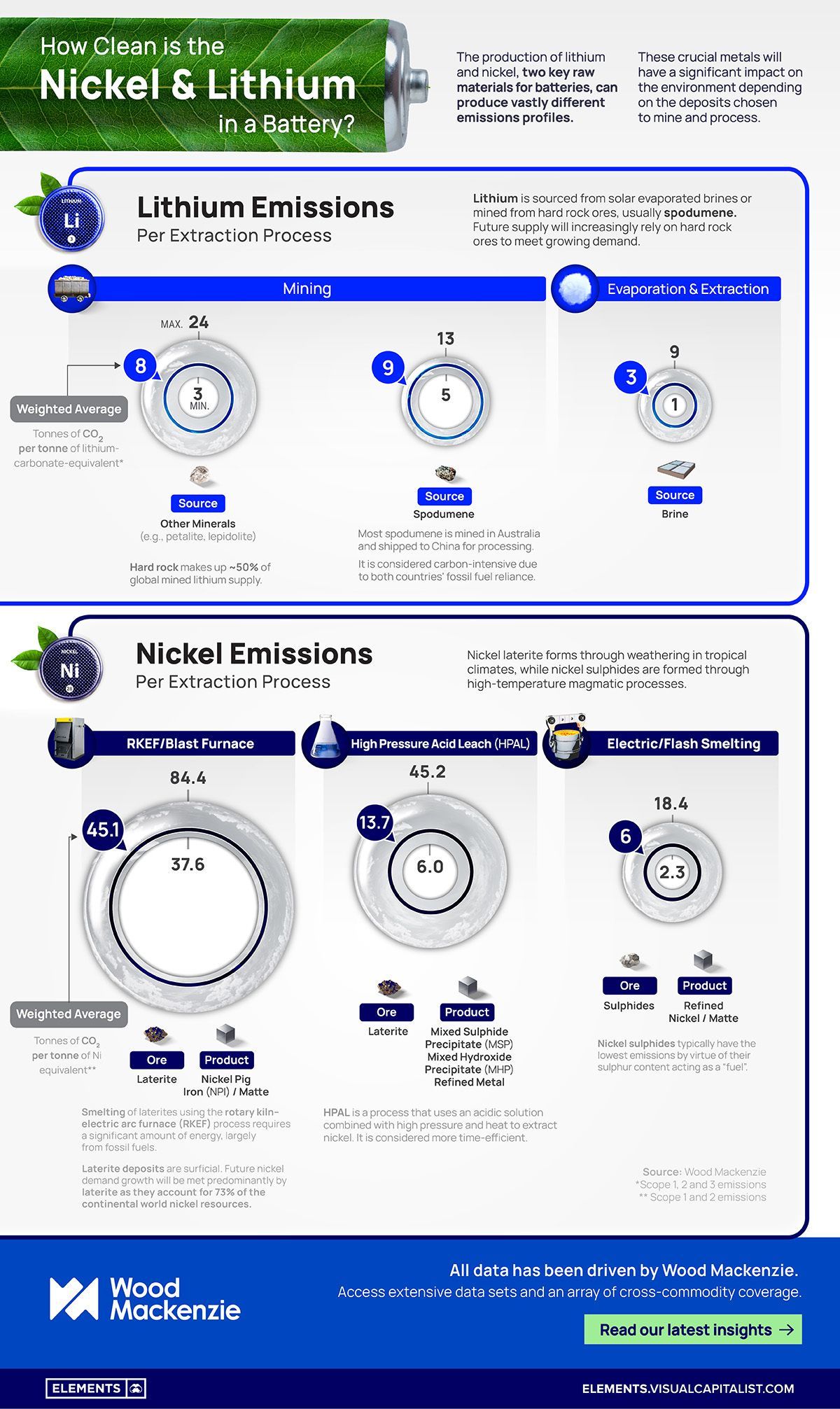
This graphic from Wood Mackenzie shows how nickel and lithium mining can significantly impact the environment, depending on the processes used for extraction.


Nickel Emissions Per Extraction Process


Nickel is a crucial metal in modern infrastructure and technology, with major uses in stainless steel and alloys. Nickel’s electrical conductivity also makes it ideal for facilitating current flow within battery cells.


Today, there are two major methods of nickel mining:

  • From laterite deposits, which are predominantly found in tropical regions. This involves open-pit mining, where large amounts of soil and overburden need to be removed to access the nickel-rich ore.
  • From sulphide ores, which involves underground or open-pit mining of ore deposits containing nickel sulphide minerals.

Although nickel laterites make up 70% of the world’s nickel reserves, magmatic sulphide deposits produced 60% of the world’s nickel over the last 60 years.


Compared to laterite extraction, sulphide mining typically emits fewer tonnes of CO2 per tonne of nickel equivalent as it involves less soil disturbance and has a smaller physical footprint:

Ore Type Process Product Tonnes of CO2 per tonne of Ni equivalent
Sulphides Electric / Flash Smelting Refined Ni / Matte 6
Laterite High Pressure Acid Leach (HPAL) Refined Ni / Mixed Sulpide Precipitate / Mixed Hydroxide Precipitate 13.7
Laterite Blast Furnace / RKEF Nickel Pig Iron / Matte 45.1

Nickel extraction from laterites can impose significant environmental impacts, such as deforestation, habitat destruction, and soil erosion.


Additionally, laterite ores often contain high levels of moisture, requiring energy-intensive drying processes to prepare them for further extraction. After extraction, the smelting of laterites requires a significant amount of energy, which is largely sourced from fossil fuels.


Although sulphide mining is cleaner, it poses other environmental challenges. The extraction and processing of sulphide ores can release sulphur compounds and heavy metals into the environment, potentially leading to acid mine drainage and contamination of water sources if not managed properly.


In addition, nickel sulphides are typically more expensive to mine due to their hard rock nature.


Lithium Emissions Per Extraction Process


Lithium is the major ingredient in rechargeable batteries found in phones, hybrid cars, electric bikes, and grid-scale storage systems. 


Today, there are two major methods of lithium extraction:

  • From brine, pumping lithium-rich brine from underground aquifers into evaporation ponds, where solar energy evaporates the water and concentrates the lithium content. The concentrated brine is then further processed to extract lithium carbonate or hydroxide.
  • Hard rock mining, or extracting lithium from mineral ores (primarily spodumene) found in pegmatite deposits. Australia, the world’s leading producer of lithium (46.9%), extracts lithium directly from hard rock.


Brine extraction is typically employed in countries with salt flats, such as Chile, Argentina, and China. It is generally considered a lower-cost method, but it can have environmental impacts such as water usage, potential contamination of local water sources, and alteration of ecosystems.


The process, however, emits fewer tonnes of CO2 per tonne of lithium-carbonate-equivalent (LCE) than mining:

Source Ore Type Process Tonnes of CO2 per tonne of LCE
Mineral Spodumene Mine 9
Mineral Petalite, lepidolite and others Mine 8
Brine N/A Extraction/Evaporation 3

Mining involves drilling, blasting, and crushing the ore, followed by flotation to separate lithium-bearing minerals from other minerals. This type of extraction can have environmental impacts such as land disturbance, energy consumption, and the generation of waste rock and tailings.


Sustainable Production of Lithium and Nickel


Environmentally responsible practices in the extraction and processing of nickel and lithium are essential to ensure the sustainability of the battery supply chain.


This includes implementing stringent environmental regulations, promoting energy efficiency, reducing water consumption, and exploring cleaner technologies. Continued research and development efforts focused on improving extraction methods and minimizing environmental impacts are crucial.


Sign up to Wood Mackenzie’s Inside Track to learn more about the impact of an accelerated energy transition on mining and metals.


Copyright © 2024 Visual Capitalist
April 20, 2026
TORONTO, April 20, 2026 - VVC Exploration Corporation, dba VVC Resources, (“VVC”), (TSX-V:VVC and OTCQC:VVCVF) announces the following: Option Grant The Directors granted incentive stock options under its stock option plan, to officers, directors and consultants of the Company, to purchase up to an aggregate of 14,750,000 common shares, representing 2.58% of the outstanding shares of the Company. The stock options are exercisable at a price of CA$0.05 per share expiring April 20, 2036. Twenty five percent (25%) of the options granted will vest immediately with the remaining vesting at 25% every six months. The exercise price was fixed at the minimum allowable price by the TSX Venture Exchange policies. The options, granted in accordance with the provisions of the Company's stock option plan, are subject to the TSX Venture Exchange policies and the applicable securities laws. Of the Options granted, 32.2% were to Directors, 37.3% to Officers, 18.6% to Employees and 11.9% to Consultants of the Company.  About VVC Resources VVC engages in the exploration, development, and management of natural resources - specializing in scarce and increasingly valuable materials needed to meet the growing, high-tech demands of industries such as manufacturing, technology, medicine, space travel, and the expanding green economy. Our portfolio includes a diverse set of multi-asset, high-growth projects, comprising: Helium & industrial gas production in western U.S.; Gold & associated metals operations in northern Mexico; and Strategic investments in carbon sequestration and other green energy technologies. VVC is a Canada-based, publicly-traded company on the TSXV (TSX-V:VVC). To learn more, visit our website at: www.vvcresources.com. Neither TSX Venture Exchange nor its Regulation Services Provider (as that term is defined in policies of the TSX Venture Exchange) accepts responsibility for the adequacy or accuracy of this release.
November 18, 2025
TORONTO, Nov. 18, 2025 - VVC Exploration Corporation, dba VVC Resources ("VVC" or the "Company") (TSX-V: VVC; OTC: VVCVF) announces that, after a project review, it has strategically restructured its mining projects in Mexico. This project review encompassed multiple considerations, including ongoing maintenance costs, permitting authorizations, political climate, safety, upside potential and financeability of each project and probability of achieving the projects potential. After this review, the Company has decided to: Exit the Gloria Copper Project located near Samalayuca, State of Chihuahua, Mexico. This long-standing project of the Company is expensive to maintain and is in an area that has become more politically volatile with uncertain safety. The geological potential of the project is not in question, but the ability to achieve that potential is unclear. Focus all mining exploration activity on the Cumeral Gold Project. Cumeral is the Company’s highly prospective gold project in north central Sonora Mexico. This project, while not as advanced as the Gloria Copper Project, has a huge upside potential. It is in an area where there is strong local support for the project and a higher likelihood of permitting and implementation success. The Cumeral Gold Project is a 1,665-hectare property in northern Sonora near Imuris which exhibits quartz-vein–hosted gold in a detachment-fault/orogenic setting with a documented NNW–SSE mineralized trend of ~4 km. Historical work reported that ~36% of 407 grab/chip samples assayed 0.1–10 g/t Au; soil surveys outlined additional anomalies (47 samples >0.020 ppm Au); and air-track drilling intersected broad, near-surface intervals of 0.21–0.44 g/t Au over 6–26 m in key target areas. The Company will continue activities on the Cumeral Gold Project. Rationale and Next Steps The Company’s decision reflects consideration of cost discipline, safety and risk management. The exit from the Gloria Copper Project will reduce future cash outlays for care, maintenance, and permitting at amid uncertainty over permit viability and broader political conditions in Chihuahua State. Capital and management resources will be reallocated to the Cumeral Gold Project exploration, and to development of the Company’s helium/natural gas project in the Central Kansas Uplift (CKU) Project where existing infrastructure and near-term activities offer a clearer path to execution. « There are opportunity costs in every project, » said Jim Culver, CEO. « Exiting the Gloria Copper Project will allow the Company to concentrate resources on projects with an obvious direct and timely route to advancing development while maintaining discipline on risk and spending. » About VVC Resources VVC engages in the exploration, development, and management of natural resources - specializing in scarce and increasingly valuable materials needed to meet the growing, high-tech demands of industries such as manufacturing, technology, medicine, space travel, and the expanding green economy. Our portfolio includes a diverse set of multi-asset high-growth projects, comprising: Helium & industrial gas production in western U.S.; Gold & associated metals operations in northern Mexico; and Strategic investments in carbon sequestration and other green energy technologies. VVC is a Canada-based, publicly-traded company on the TSXV (TSX-V:VVC). To learn more, visit our website at: www.vvcresources.com. Neither TSX Venture Exchange nor its Regulation Services Provider (as that term is defined in policies of the TSX Venture Exchange) accepts responsibility for the adequacy or accuracy of this release. 
Show More >