
A Lifetime’s Consumption of Fossil Fuels, Visualized
May 20, 2024

Visualizing the Fossil Fuels we Consume in a Lifetime


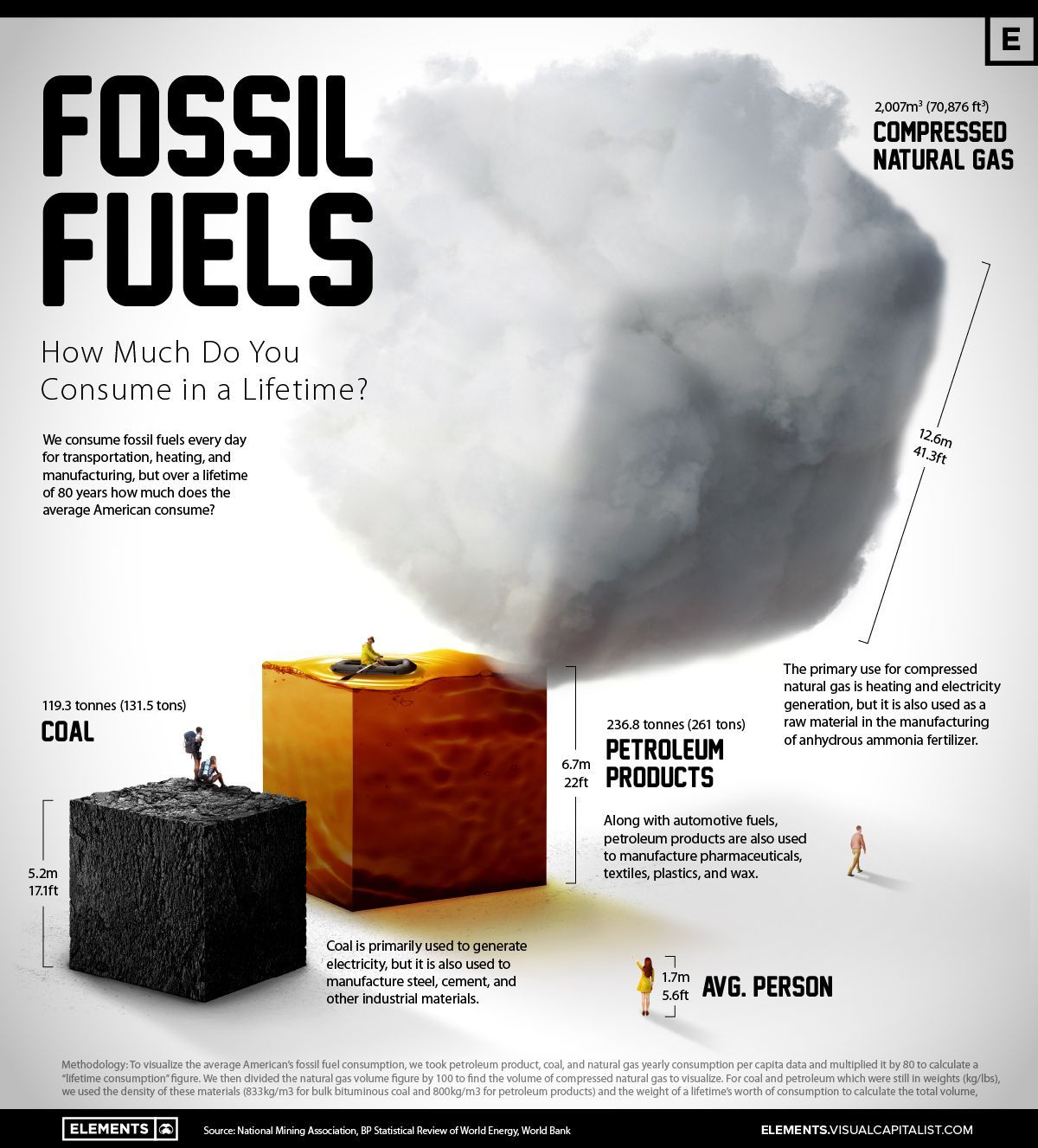
From burning natural gas to heat our homes to the petroleum-based materials found in everyday products like pharmaceuticals and plastics, we all consume fossil fuels in one form or another.

In 2021, the world consumed nearly 490 exajoules of fossil fuels, an unfathomable figure of epic proportions.


To put fossil fuel consumption into perspective on a more individual basis, this graphic visualizes the average person’s fossil fuel use over a lifetime of 80 years using data from the National Mining Association and BP’s Statistical Review of World Energy.


How Many Fossil Fuels a Person Consumes Every Year


On a day-to-day basis, our fossil fuel consumption might seem minimal, however, in just a year the average American consumes more than 23 barrels of petroleum products like gasoline, propane, or jet fuel.


The cube of the average individual’s yearly petroleum product consumption reaches around 1.5 meters (4.9 feet) tall. When you consider varying transportation choices and lifestyles, from public transit to private jets, the yearly cube of petroleum product consumption for some people may easily overtake their height.
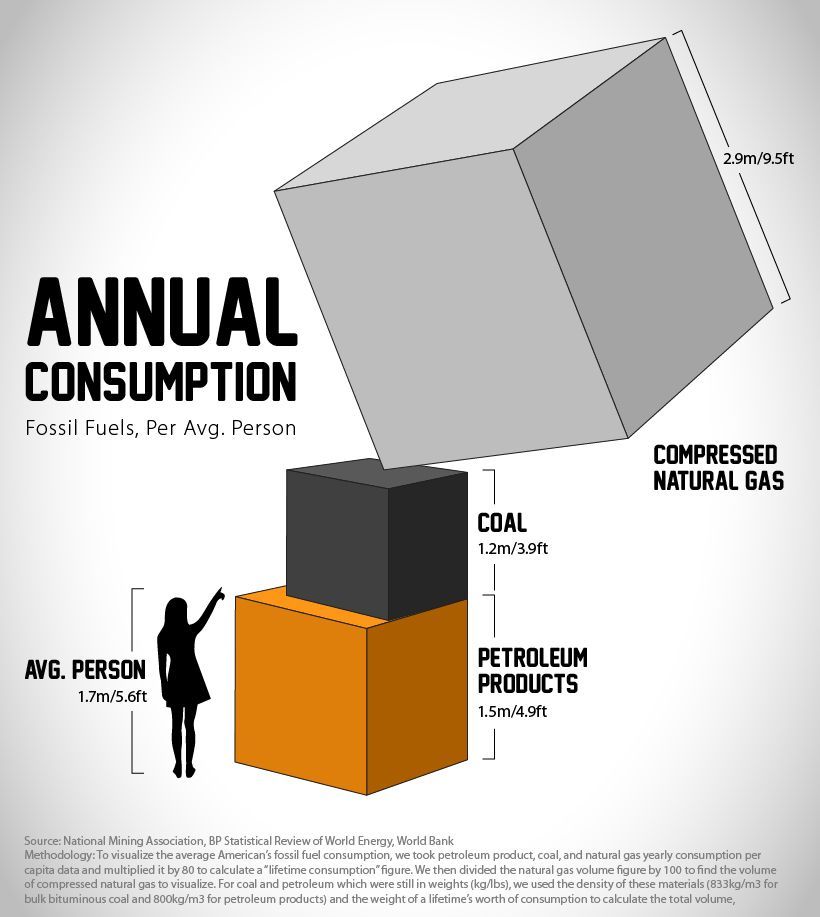
To calculate the volume needed to visualize the petroleum products and coal cubes (natural gas figures were already in volume format), we used the densities of bulk bituminous coal (833kg/m3) and petroleum products (800kg/m3) along with the weights of per capita consumption in the U.S. from the National Mining Association.


These figures are averages, and can differ per person depending on a region’s energy mix, transportation choices, and consumption habits, along with other factors.


Global Fossil Fuel Consumption Rebounds Post-Pandemic


When the global economy reopened post-pandemic, energy demand and consumption rebounded past 2019 levels with fossil fuels largely leading the way. While global primary energy demand grew 5.8% in 2021, coal consumption rose by 6% reaching highs not seen since 2014.


In 2021, renewables and hydroelectricity made up nearly 14% of the world’s primary energy use, with fossil fuels (oil, natural gas, and coal) accounting for 82% (down from 83% in 2020), and nuclear energy accounting for the remaining 4%.


Recent demand for fossil fuels has been underpinned by their reliability as generating energy from renewables in Germany has been inconsistent when it’s been needed most.


Now the country grapples with energy rations as it restarts coal-fired power plants in response to its overdependence on Russian fossil fuel energy as the potential permanence of the Nord Stream 1 natural gas pipeline shutdown looms.


Growing Green Energy Amidst Geopolitical Instability


Domestic energy and material supply chain independence quickly became a top priority for many nations amidst Russia’s invasion of Ukraine, Western trade sanctions, and increasingly unpredictable COVID-19 lockdowns in China.


Trade and energy dependence risks still remain a major concern as many nations transition towards renewable energy. For example, essential rare earth mineral production, and solar PV manufacturing supply chains remain dominated by China.


Despite looming storm clouds over global energy and materials trade, renewable energy’s green linings are growing on the global scale. The world’s renewable primary energy consumption reached an annual growth rate of 15%, outgrowing all other energy fuels as wind and solar provided a milestone 10% of global electricity in 2021.


If the global energy mix continues to get greener fast enough, the cubes of our personal fossil fuel consumption may manage to get smaller in the future.


Copyright © 2024 Visual Capitalist
April 20, 2026
TORONTO, April 20, 2026 - VVC Exploration Corporation, dba VVC Resources, (“VVC”), (TSX-V:VVC and OTCQC:VVCVF) announces the following: Option Grant The Directors granted incentive stock options under its stock option plan, to officers, directors and consultants of the Company, to purchase up to an aggregate of 14,750,000 common shares, representing 2.58% of the outstanding shares of the Company. The stock options are exercisable at a price of CA$0.05 per share expiring April 20, 2036. Twenty five percent (25%) of the options granted will vest immediately with the remaining vesting at 25% every six months. The exercise price was fixed at the minimum allowable price by the TSX Venture Exchange policies. The options, granted in accordance with the provisions of the Company's stock option plan, are subject to the TSX Venture Exchange policies and the applicable securities laws. Of the Options granted, 32.2% were to Directors, 37.3% to Officers, 18.6% to Employees and 11.9% to Consultants of the Company.  About VVC Resources VVC engages in the exploration, development, and management of natural resources - specializing in scarce and increasingly valuable materials needed to meet the growing, high-tech demands of industries such as manufacturing, technology, medicine, space travel, and the expanding green economy. Our portfolio includes a diverse set of multi-asset, high-growth projects, comprising: Helium & industrial gas production in western U.S.; Gold & associated metals operations in northern Mexico; and Strategic investments in carbon sequestration and other green energy technologies. VVC is a Canada-based, publicly-traded company on the TSXV (TSX-V:VVC). To learn more, visit our website at: www.vvcresources.com. Neither TSX Venture Exchange nor its Regulation Services Provider (as that term is defined in policies of the TSX Venture Exchange) accepts responsibility for the adequacy or accuracy of this release.
November 18, 2025
TORONTO, Nov. 18, 2025 - VVC Exploration Corporation, dba VVC Resources ("VVC" or the "Company") (TSX-V: VVC; OTC: VVCVF) announces that, after a project review, it has strategically restructured its mining projects in Mexico. This project review encompassed multiple considerations, including ongoing maintenance costs, permitting authorizations, political climate, safety, upside potential and financeability of each project and probability of achieving the projects potential. After this review, the Company has decided to: Exit the Gloria Copper Project located near Samalayuca, State of Chihuahua, Mexico. This long-standing project of the Company is expensive to maintain and is in an area that has become more politically volatile with uncertain safety. The geological potential of the project is not in question, but the ability to achieve that potential is unclear. Focus all mining exploration activity on the Cumeral Gold Project. Cumeral is the Company’s highly prospective gold project in north central Sonora Mexico. This project, while not as advanced as the Gloria Copper Project, has a huge upside potential. It is in an area where there is strong local support for the project and a higher likelihood of permitting and implementation success. The Cumeral Gold Project is a 1,665-hectare property in northern Sonora near Imuris which exhibits quartz-vein–hosted gold in a detachment-fault/orogenic setting with a documented NNW–SSE mineralized trend of ~4 km. Historical work reported that ~36% of 407 grab/chip samples assayed 0.1–10 g/t Au; soil surveys outlined additional anomalies (47 samples >0.020 ppm Au); and air-track drilling intersected broad, near-surface intervals of 0.21–0.44 g/t Au over 6–26 m in key target areas. The Company will continue activities on the Cumeral Gold Project. Rationale and Next Steps The Company’s decision reflects consideration of cost discipline, safety and risk management. The exit from the Gloria Copper Project will reduce future cash outlays for care, maintenance, and permitting at amid uncertainty over permit viability and broader political conditions in Chihuahua State. Capital and management resources will be reallocated to the Cumeral Gold Project exploration, and to development of the Company’s helium/natural gas project in the Central Kansas Uplift (CKU) Project where existing infrastructure and near-term activities offer a clearer path to execution. « There are opportunity costs in every project, » said Jim Culver, CEO. « Exiting the Gloria Copper Project will allow the Company to concentrate resources on projects with an obvious direct and timely route to advancing development while maintaining discipline on risk and spending. » About VVC Resources VVC engages in the exploration, development, and management of natural resources - specializing in scarce and increasingly valuable materials needed to meet the growing, high-tech demands of industries such as manufacturing, technology, medicine, space travel, and the expanding green economy. Our portfolio includes a diverse set of multi-asset high-growth projects, comprising: Helium & industrial gas production in western U.S.; Gold & associated metals operations in northern Mexico; and Strategic investments in carbon sequestration and other green energy technologies. VVC is a Canada-based, publicly-traded company on the TSXV (TSX-V:VVC). To learn more, visit our website at: www.vvcresources.com. Neither TSX Venture Exchange nor its Regulation Services Provider (as that term is defined in policies of the TSX Venture Exchange) accepts responsibility for the adequacy or accuracy of this release. 
Show More >