
What’s Made from a Barrel of Oil?
July 11, 2024

What Products Are Made from a Barrel of Oil?


This was originally posted on Elements. Sign up to the free mailing list to get beautiful visualizations on natural resource megatrends in your email every week.


From the gasoline in our cars to the plastic in countless everyday items, crude oil is an essential raw material that shows up everywhere in our lives.


With around 18 million barrels of crude oil consumed every day just in America, this commodity powers transport, utilities, and is a vital ingredient in many of the things we use on a daily basis.


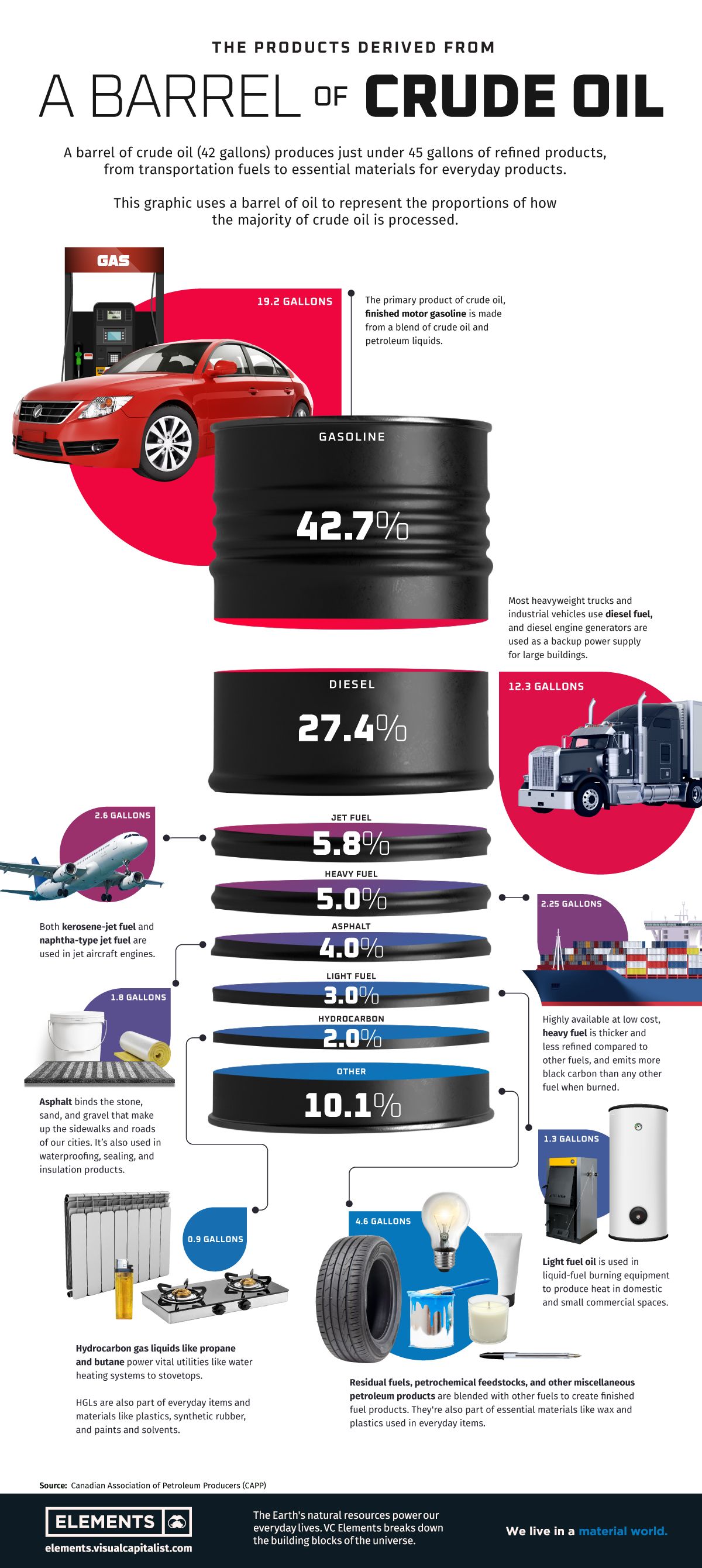
This graphic visualizes how much crude oil is refined into various finished products, using a barrel of oil to represent the proportional breakdown.


Barrel of Oil to Functional Fuel and More


Crude oil is primarily refined into various types of fuels to power transport and vital utilities. More than 85% of crude oil is refined into fuels like gasoline, diesel, and hydrocarbon gas liquids (HGLs) like propane and butane.


Along with being fuels for transportation, heating, and cooking, HGLs are used as feedstock for the production of chemicals, plastics, and synthetic rubber, and as additives for motor gasoline production.

Refined Crude Oil Product Share of Crude Oil Refined
Gasoline 42.7%
Diesel 27.4%
Jet fuel 5.8%
Heavy fuel 5.0%
Asphalt 4.0%
Light fuel 3.0%
Hydrocarbon gas liquids 2.0%
Other 10.1%

Source: Canadian Association of Petroleum Producers


Crude oil not only powers our vehicles, but it also helps pave the roads we drive on. About 4% of refined crude oil becomes asphalt, which is used to make concrete and different kinds of sealing and insulation products.


Although transportation and utility fuels dominate a large proportion of refined products, essential everyday materials like wax and plastic are also dependent on crude oil. With about 10% of refined products used to make plastics, cosmetics, and textiles, a barrel of crude oil can produce a variety of unexpected everyday products.


Personal care products like cosmetics and shampoo are made using petroleum products, as are medical supplies like IV bags and pharmaceuticals. Modern life would look very different without crude oil.


The Process of Refining Crude Oil


You might have noticed that while a barrel of oil contains 42 gallons, it ends up producing 45 gallons of refined products. This is because the majority of refined products have a lower density than crude oil, resulting in an increase in volume that is called processing gain.


Along with this, there are other inputs aside from crude oil that are used in the refining process. While crude oil is the primary input, fuel ethanol, hydrocarbon gas liquids, and other blending liquids are also used.

U.S. Refiner and Blender Inputs Share of Total
Crude oil 85.4%
Fuel ethanol 4.8%
Blending components 3.5%
Hydrocarbon gas liquids 3.0%
Other liquids 3.3%

Source: EIA


The process of refining a 30,000-barrel batch of crude oil typically takes between 12-24 hours, with refineries operating 24 hours a day, 365 days a year. Although the proportions of individual refined products can vary depending on market demand and other factors, the majority of crude oil will continue to become fuel for the world’s transport and utilities.


The Difficulty of Cutting Down on Crude Oil


From the burning of heavy fuels that tarnish icebergs found in Arctic waters to the mounds of plastic made with petrochemicals that end up in our rivers, each barrel of oil and its refined products impact our environment in many different ways.


But even as the world works to reduce its consumption of fossil fuels in order to reach climate goals, a world without crude oil seems unfathomable.


Skyrocketing sales of EVs still haven’t managed to curb petroleum consumption in places like Norway, California, and China, and the steady reopening of travel and the economy will only result in increased petroleum consumption.


Completely replacing the multi-faceted “black gold” that’s in a barrel of oil isn’t possible right now, but as electrification continues and we find alternatives to petrochemical materials, humanity might at least manage to reduce its dependence on burning fossil fuels.


Copyright © 2024 Visual Capitalist
November 18, 2025
TORONTO, Nov. 18, 2025 - VVC Exploration Corporation, dba VVC Resources ("VVC" or the "Company") (TSX-V: VVC; OTC: VVCVF) announces that, after a project review, it has strategically restructured its mining projects in Mexico. This project review encompassed multiple considerations, including ongoing maintenance costs, permitting authorizations, political climate, safety, upside potential and financeability of each project and probability of achieving the projects potential. After this review, the Company has decided to: Exit the Gloria Copper Project located near Samalayuca, State of Chihuahua, Mexico. This long-standing project of the Company is expensive to maintain and is in an area that has become more politically volatile with uncertain safety. The geological potential of the project is not in question, but the ability to achieve that potential is unclear. Focus all mining exploration activity on the Cumeral Gold Project. Cumeral is the Company’s highly prospective gold project in north central Sonora Mexico. This project, while not as advanced as the Gloria Copper Project, has a huge upside potential. It is in an area where there is strong local support for the project and a higher likelihood of permitting and implementation success. The Cumeral Gold Project is a 1,665-hectare property in northern Sonora near Imuris which exhibits quartz-vein–hosted gold in a detachment-fault/orogenic setting with a documented NNW–SSE mineralized trend of ~4 km. Historical work reported that ~36% of 407 grab/chip samples assayed 0.1–10 g/t Au; soil surveys outlined additional anomalies (47 samples >0.020 ppm Au); and air-track drilling intersected broad, near-surface intervals of 0.21–0.44 g/t Au over 6–26 m in key target areas. The Company will continue activities on the Cumeral Gold Project. Rationale and Next Steps The Company’s decision reflects consideration of cost discipline, safety and risk management. The exit from the Gloria Copper Project will reduce future cash outlays for care, maintenance, and permitting at amid uncertainty over permit viability and broader political conditions in Chihuahua State. Capital and management resources will be reallocated to the Cumeral Gold Project exploration, and to development of the Company’s helium/natural gas project in the Central Kansas Uplift (CKU) Project where existing infrastructure and near-term activities offer a clearer path to execution. « There are opportunity costs in every project, » said Jim Culver, CEO. « Exiting the Gloria Copper Project will allow the Company to concentrate resources on projects with an obvious direct and timely route to advancing development while maintaining discipline on risk and spending. » About VVC Resources VVC engages in the exploration, development, and management of natural resources - specializing in scarce and increasingly valuable materials needed to meet the growing, high-tech demands of industries such as manufacturing, technology, medicine, space travel, and the expanding green economy. Our portfolio includes a diverse set of multi-asset high-growth projects, comprising: Helium & industrial gas production in western U.S.; Gold & associated metals operations in northern Mexico; and Strategic investments in carbon sequestration and other green energy technologies. VVC is a Canada-based, publicly-traded company on the TSXV (TSX-V:VVC). To learn more, visit our website at: www.vvcresources.com. Neither TSX Venture Exchange nor its Regulation Services Provider (as that term is defined in policies of the TSX Venture Exchange) accepts responsibility for the adequacy or accuracy of this release. 
h
October 9, 2025
TORONTO, Oct. 09, 2025 - VVC Exploration Corporation, dba VVC Resources ("VVC" or the "Company") (TSX-V: VVC; OTC: VVCVF) announces that Plateau Helium Corporation ("PHC"), a wholly owned subsidiary of the Company, has completed the purchase of the Ithaca 1-17 well together with approximately five miles of associated pipeline located in Rush county, Kansas in a prolific helium, gas and oil area known as the Central Kansas Uplift (CKU). The acquisition was initiated in April 2025 and PHC took possession in July 2025. As previously disclosed in our May 30, June 26 and September 2025 MD&As, PHC has a 50% operating interest in the well. The CKU Project targets helium-rich natural gas within multiple stacked reservoirs in Rush and Pawnee Counties, Kansas, where PHC has now assembled a meaningful lease position, acquired one producing property (Ithaca 1-17) and associated gas gathering system, and identified multiple development well locations. The acquisition of an existing gas gathering system serves to lower initial development cost while expediting the time needed to commence gas/helium sales and provide cashflow. « Building on a producing asset while securing midstream capacity is a practical way to de-risk our development program in the CKU, » said Bill Kerrigan, President of VVC and PHC. « The Ithaca 1-17 well and pipeline give us a backbone to bring wells online more efficiently. » About VVC Resources VVC engages in the exploration, development, and management of natural resources - specializing in scarce and increasingly valuable materials needed to meet the growing, high-tech demands of industries such as manufacturing, technology, medicine, space travel, and the expanding green economy. Our portfolio includes a diverse set of multi-asset, high-growth projects, comprising: Helium & industrial gas production in western U.S.; Gold & associated metals operations in northern Mexico; and Strategic investments in carbon sequestration and other green energy technologies. VVC is a Canada-based, publicly-traded company on the TSXV (TSX-V:VVC). To learn more, visit our website at: www.vvcresources.com.  Neither TSX Venture Exchange nor its Regulation Services Provider (as that term is defined in policies of the TSX Venture Exchange) accepts responsibility for the adequacy or accuracy of this release.
Show More >