

Explainer: What Key Factors Influence Gas Prices?
April 4, 2024

By  Graphics/Design: Miranda Smith | Clayton Wadsworth
Explainer: What Key Factors Influence Gas Prices?


Across the United States, the cost of gas has been a hot topic of conversation lately, as prices reach record-breaking highs.

The national average now sits at $5.00 per gallon, and by the end of summer, this figure could grow to $6 per gallon, according to estimates by JPMorgan.


But before we can have an understanding of what’s happening at the pump, it’s important to first know what key factors dictate the price of gas.


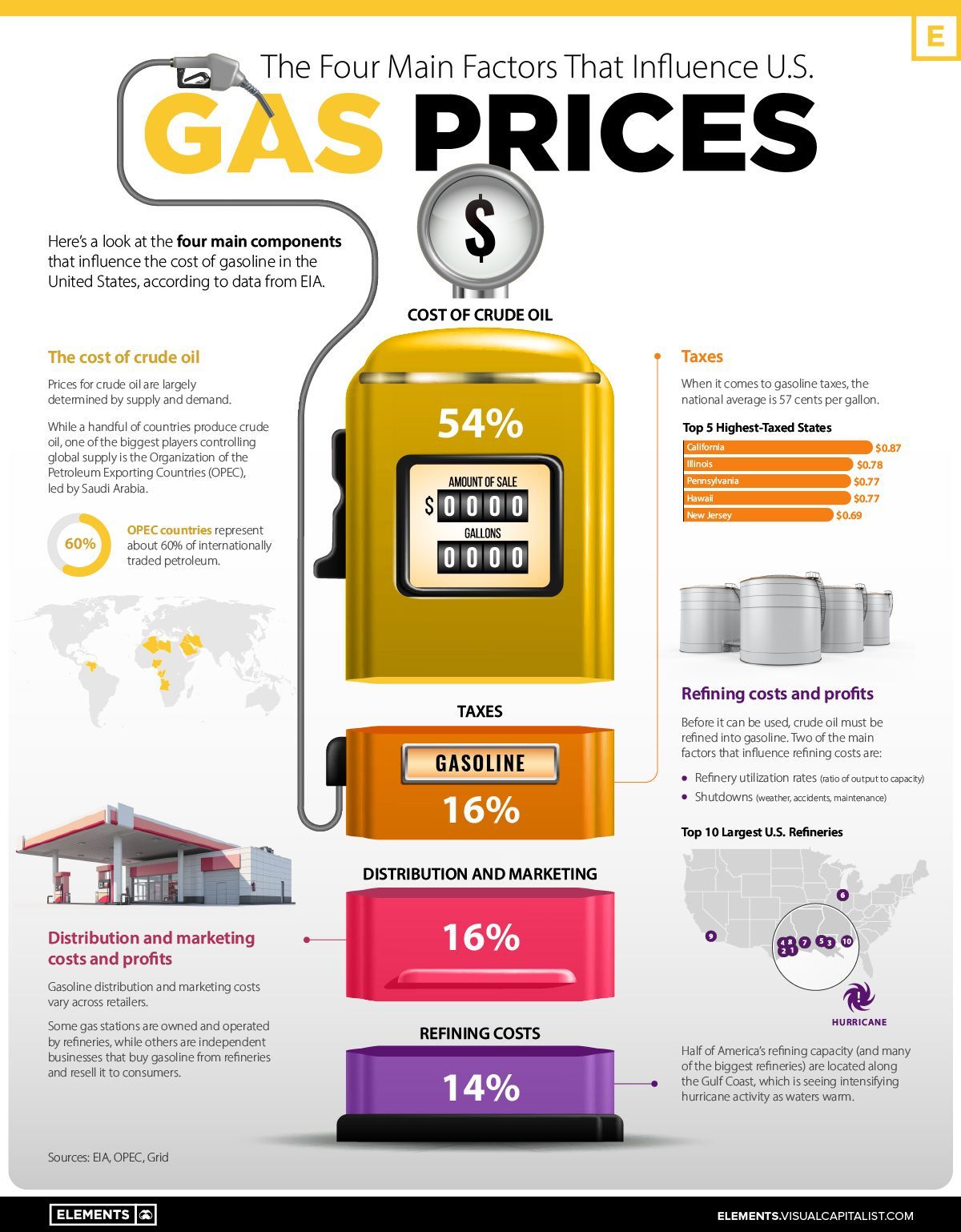
This graphic, using data from the U.S. Energy Information Administration (EIA), outlines the main components that influence gas prices, providing each factor’s proportional impact on price.


The Four Main Factors


According to the EIA, there are four main factors that influence the price of gas:

  • Crude oil prices (54%)
  • Refining costs (14%)
  • Taxes (16%)
  • Distribution, and marketing costs (16%)


More than half the cost of filling your tank is influenced by the price of crude oil. Meanwhile, the rest of the price at the pump is split fairly equally between refining costs, marketing and distribution, and taxes.


Let’s look at each factor in more depth.


Crude Oil Prices


The most influential factor is the cost of crude oil, which is largely dictated by international supply and demand.


Despite being the world’s largest oil producer, the U.S. remains a net importer of crude oil, with the majority coming from Canada, Mexico, and Saudi Arabia. Because of America’s reliance on imports, U.S. gas prices are largely influenced by the global crude oil market.


A number of geopolitical factors can influence the crude oil market, but one of the biggest influences is the Organization of the Petroleum Exporting Countries (OPEC), led by Saudi Arabia.


Established in 1960, OPEC was created to combat U.S. dominance of the global oil market. OPEC sets production targets for its 13 member countries, and historically, oil prices have been linked to changes in OPEC production. Today, OPEC countries are responsible for about 60% of internationally traded petroleum.


Refining Costs


Oil needs to be refined into gasoline before it can be used by consumers, which is why refining costs are factored into the price of gas.


The U.S. has hundreds of refineries across the country. The country’s largest refinery, owned by the Saudi Arabian company ​​Saudi Aramco, processes around 607,000 barrels of oil per day.


The exact cost of refining varies, depending on a number of factors such as the type of crude oil used, the processing technology available at the refinery, and the gasoline requirements in specific parts of the country.


In general, refining capacity in the U.S. has not been keeping up with oil demand. Several refineries shut down throughout the pandemic, but even before COVID-19, refining capacity in the U.S. was lagging behind demand. Incredibly, there haven’t been any brand-new refining facilities built in the country since 1977.


Taxes


In the U.S., taxes also play a critical role in determining the price of gas.


Across America, the average gasoline tax is $0.57 per gallon, however, the exact amount fluctuates from state to state. Here’s a look at the top five states with the highest gas taxes:

Rank State Gas tax (per gallon)
1 California $0.87
2 Illinois $0.78
3 Pennsylvania $0.77
4 Hawaii $0.77
5 New Jersey $0.69

*Note: figures include both state and federal tax


States with high gas taxes usually spend the extra money on improvements to their infrastructure or local transportation. For instance, Illinois doubled its gas taxes in 2019 as part of a $45 billion infrastructure plan.


California, the state with the highest tax on gas, is expecting to see a rate increase this July, which will drive gas prices up by around three cents per gallon.


Distribution and Marketing Costs


Lastly, the costs of distribution and marketing have an impact on the price of gas.


Gasoline is typically shipped from refineries to local terminals via pipelines. From there, the gasoline is processed further to ensure it meets market requirements or local government standards.


Gas stations then distribute the final product to the consumer. The cost of running a gas station varies—some gas stations are owned and operated by brand-name refineries like Chevron, while others are smaller-scale operations owned by independent merchants.


The big-name brands run a lot of advertisements. According to Morning Consult, Chevron, BP PLC, Exxon Mobil Corp., and Royal Dutch Shell PLC aired TV advertisements in the U.S. more than 44,495 times between June 1, 2020, and Aug. 31, 2021.


How Does the Russia-Ukraine Conflict Impact U.S. Gas Prices?


If only a fraction of America’s oil comes from Russia, why is the Russia-Ukraine conflict impacting prices in the U.S.?

Because oil is bought and sold on a global commodities market. So, when countries imposed sanctions on Russian oil, that put a squeeze on global supply, which ultimately drove up prices.


This supply shock could keep prices high for a while unless the U.S. falls into a recession, which is a growing possibility based on how recent data is trending.


Copyright © 2024 Visual Capitalist
June 19, 2026
TORONTO, June 19, 2026 - VVC Exploration Corporation, dba VVC Resources ("VVC" or the "Company") (TSX-V: VVC and OTCQB: VVCVF) announces that Mr. Bruno Dumais resigned as a Director of the Company. The Board of Directors has accepted Mr. Dumais' resignation with regret, and thanks him for his valuable contributions and dedicated service to the Company. Jim Culver, CEO of VVC, commented: "On behalf of the Board and management, I would like to express our deep appreciation to Bruno for his commitment to VVC. We value the insight and guidance he has provided during his tenure and wish him continued success in his future endeavors." The position on the Board of Directors will be left vacant until a new candidate can be appointed to fill the vacancy. About VVC Resources VVC engages in the exploration, development, and management of natural resources - specializing in scarce and increasingly valuable materials needed to meet the growing, high-tech demands of industries such as manufacturing, technology, medicine, space travel, and the expanding green economy. Our portfolio includes a diverse set of multi-asset, high-growth projects, comprising: Helium & industrial gas production in western U.S.; Gold & associated metals operations in northern Mexico; and Strategic investments in carbon sequestration and other green energy technologies. VVC is a Canada-based, publicly-traded company on the TSXV (TSX-V:VVC). To learn more, visit our website at: www.vvcresources.com. Neither TSX Venture Exchange nor its Regulation Services Provider (as that term is defined in policies of the TSX Venture Exchange) accepts responsibility for the adequacy or accuracy of this release.
May 21, 2026
TORONTO, May 21, 2026 - VVC Exploration Corporation, dba VVC Resources (“VVC” or the “Company”) (TSX-V: VVC and OTCQB: VVCVF) is providing an update to its previous news release dated May 16, 2026, regarding the status of its annual financial filings. The Ontario Securities Commission (the "OSC") has notified the Company that its application for a Management Cease Trade Order ("MCTO") has been rejected. In delivering its decision, the OSC noted that they are not of the view that there is an active, liquid market for the issuer’s securities, based on a review of the trade volume, trade value, and number of trades over the last month. Consequently, the OSC intends to issue a Failure-to-File Cease Trade Order ("FFCTO") against the Company shortly after the regulatory deadline if the continuous disclosure documents are not submitted. The Company's audited annual financial statements, management's discussion and analysis, and related officer certifications for the fiscal year ended January 31, 2026 (collectively, the "Required Filings") are due on June 1, 2026. Reason for Anticipated Delay The delay in completing VVC’s Required Filings is primarily attributable to the time required to complete the valuation and related accounting assessment of VVC’s equity investment in Cyber Apps Solutions Corp. (“CYRB”) and its operating subsidiary, Proton Green, LLC. The complexity of the valuation process and the resolution of related accounting matters delayed the commencement of VVC’s Required Filings. The Company also wishes to clarify that the references to executive management vacancies at CYRB included in the May 16, 2026 announcement were incorrect and have been retracted. Financing & Corporate Update In light of the operational adjustments required by the developments at CYRB, the Company also announces that it is actively pursuing capital-raising initiatives to protect working capital and fund ongoing operations, including its core helium and gold exploration assets. VVC is currently evaluating various financing options, which may include a proposed non-brokered private placement of securities. Any such financing remains subject to compliance with the strict terms of the proposed MCTO, which prohibits the issuance or acquisition of securities from any director, officer, or insider of VVC during the period of the default. Further details regarding the terms, pricing, and closing dates of any such financing will be announced if and when they are finalized. There can be no assurance that any financing will be completed on terms acceptable to the Company, or at all. Anticipated Completion and Impact of Order The Company and its independent third-party valuation specialist are working diligently to resolve the valuation framework with MNP LLP. VVC continues to target the completion and submission of the Required Filings on or before June 30, 2026. If an FFCTO is issued by the principal regulator, trading in the common shares of VVC will be suspended across all trading platforms in Canada, including the TSX Venture Exchange, until the Required Filings are completed and the order is formally revoked by the regulators. Insider Trading Restrictions The Company's internal insider trading blackout notice issued by the Corporate Secretary remains in full effect. All directors, officers, and insiders are strictly prohibited from trading in the Company's securities or exercising stock options until the default is fully remedied and the Required Filings are publicly available. About VVC Resources VVC engages in the exploration, development, and management of natural resources - specializing in scarce and increasingly valuable materials needed to meet the growing, high-tech demands of industries such as manufacturing, technology, medicine, space travel, and the expanding green economy. Our portfolio includes a diverse set of multi-asset, high-growth projects, comprising: Helium & industrial gas production in western U.S.; Gold & associated metals operations in northern Mexico; and Strategic investments in carbon sequestration and other green energy technologies. VVC is a Canada-based, publicly-traded company on the TSXV (TSX-V:VVC). To learn more, visit our website at: www.vvcresources.com. Neither TSX Venture Exchange nor its Regulation Services Provider (as that term is defined in policies of the TSX Venture Exchange) accepts responsibility for the adequacy or accuracy of this release.
Show More >